Physical Address
304 North Cardinal St.
Dorchester Center, MA 02124
Physical Address
304 North Cardinal St.
Dorchester Center, MA 02124
A clear beginner's guide to how numerology works — what numerology is, the core idea behind it, the key numbers like life path and destiny, the main systems, and how to start reading your own numbers.
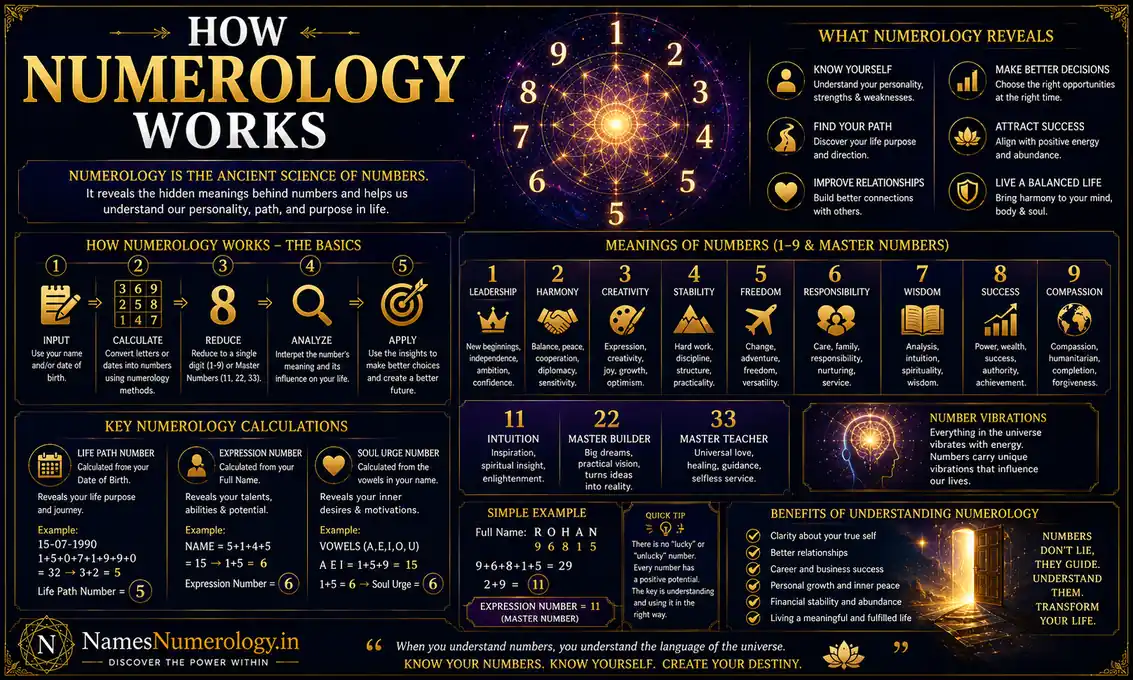
Numerology turns names and dates into numbers, and reads those numbers as clues to personality, strengths and life direction. If you have ever wondered how numerology works — where the numbers come from, what they mean, and how people “read” them — this beginner’s guide explains the whole system in plain language, from the core idea to the key numbers and how to calculate your own.
Numerology is the belief that numbers carry meaning beyond their mathematical value — that each number has its own energy, personality and symbolism. It is also the study of the number value of letters, which is how a name can be turned into a number. When applied to a person’s name and date of birth, numerology is used to describe character, talents and the broad shape of a life.
It is an ancient idea: number symbolism appears across many cultures and thousands of years of history. The modern Western system is often linked to the Greek mathematician Pythagoras, while the older Chaldean system — widely used in India — traces back to ancient Babylon. Both reduce names and dates to single digits, but assign letter values differently.
Importantly, numerology is a belief system, not a science. There is no scientific evidence that numbers determine personality or predict events. It is best approached as a tool for reflection and self-understanding.
The whole system rests on one simple mechanic: reduction to a single digit. Almost everything in numerology comes down to the numbers 1 through 9, plus the three “master numbers” (11, 22, 33). Any larger number — a birth date, the total of a name, a phone number — is added together and reduced step by step until a single digit remains.
For example: 1987 → 1 + 9 + 8 + 7 = 25 → 2 + 5 = 7.
Each of those final single digits has a set of traits, and reading numerology is largely about working out a person’s key numbers and interpreting what they mean together. You can see the meaning of every digit in our guide to numerology numbers meaning.
You are not just “one number.” A full reading uses several, each describing a different part of you:
The same digit means the same core thing wherever it appears — a 5 is always about freedom and change — but it expresses that energy in a different area depending on which number it is.
The nine single digits are the alphabet of numerology, each with its own personality — for example 1 leads, 4 builds, 8 commands and 9 gives. The three master numbers (11, 22, 33) are treated as intensified versions of 2, 4 and 6 and are usually not reduced. Rather than repeat them here, the full meanings of all twelve are in our pillar guide, numerology numbers meaning.
Because names become numbers, the system you use matters — the same name can total differently under each:
We compare them in detail, with both letter charts, in Chaldean vs Pythagorean numerology and how to calculate your name number.
To do a basic reading of yourself:
From there, the same principles extend to practical questions people use numerology for every day — whether a name is lucky for them, choosing a lucky mobile number, or picking a business name.
Used honestly, numerology can be a fun, thought-provoking lens for reflecting on your strengths, tendencies and choices — and many people find that framing genuinely useful. What it cannot do is predict the future, guarantee outcomes, or replace real effort and sound decisions. There is no scientific basis for its predictive claims, so treat it as a tool for insight and positive intent rather than fact, and make important life decisions on practical grounds.
Numerology converts names and dates into numbers, reduces them to single digits (1–9, plus master numbers 11, 22, 33), and interprets each number’s traits. A reading combines several key numbers — like the life path and name numbers — to describe personality and direction.
It is the belief that numbers carry meaning and energy, and the practice of turning your name and birth date into numbers to learn about your character, strengths and life path.
The life path number (from your date of birth) is the most important, followed by the destiny, soul urge and personality numbers (from your name). Together they form the core of a reading.
The Pythagorean system is the simplest to start with, while the Chaldean system is widely used in India and considered more precise for names. Beginners often learn Pythagorean first, then explore Chaldean.
Yes. The basics are straightforward: learn how to calculate your life path and name numbers, then look up what each number means. Reading several numbers together takes a little practice but is very learnable.
No. Numerology is a belief system with no scientific support for its predictive claims. It is best used as a tool for reflection and self-understanding, not as a basis for important decisions.

