
Chaldean Numerology Calculation Method: The Complete Practical Guide
Of the major numerology systems in use today, the Chaldean system is considered by many practitioners to be the oldest and most accurate — particularly for name analysis and name correction. While the Pythagorean system is more commonly taught in Western numerology courses, experienced Indian and Middle Eastern numerologists almost universally prefer Chaldean for its depth and precision.
This guide explains exactly how the Chaldean numerology method works, provides the complete Chaldean letter value chart, and walks you through how to perform calculations step by step.
What Is Chaldean Numerology?
The Chaldean system of numerology originated in ancient Babylon (modern-day Iraq) with the Chaldean people, who were renowned throughout the ancient world for their astronomical knowledge and mystical scholarship. This system was later carried through Kabbalistic and Vedic traditions and became deeply integrated into Indian numerology practice.
The key distinguishing features of Chaldean numerology are:
- The number 9 has no letter assignment. In Chaldean tradition, 9 is considered a sacred, complete number and is not assigned to any letter.
- Compound numbers carry independent meaning. Before reducing to a single digit, the two-digit compound number is analyzed for its own significance. This is a crucial element that the Pythagorean system largely ignores.
- The system is based on sound vibration, not sequential assignment — letters are assigned values based on their believed sonic vibration, not their alphabetical order.
- The name used in daily life matters — unlike Pythagorean practice, which typically uses the full birth name, Chaldean numerologists often analyze the name as it is actually used, because they believe the vibration of a name is reinforced by usage.
The Chaldean Letter Value Chart
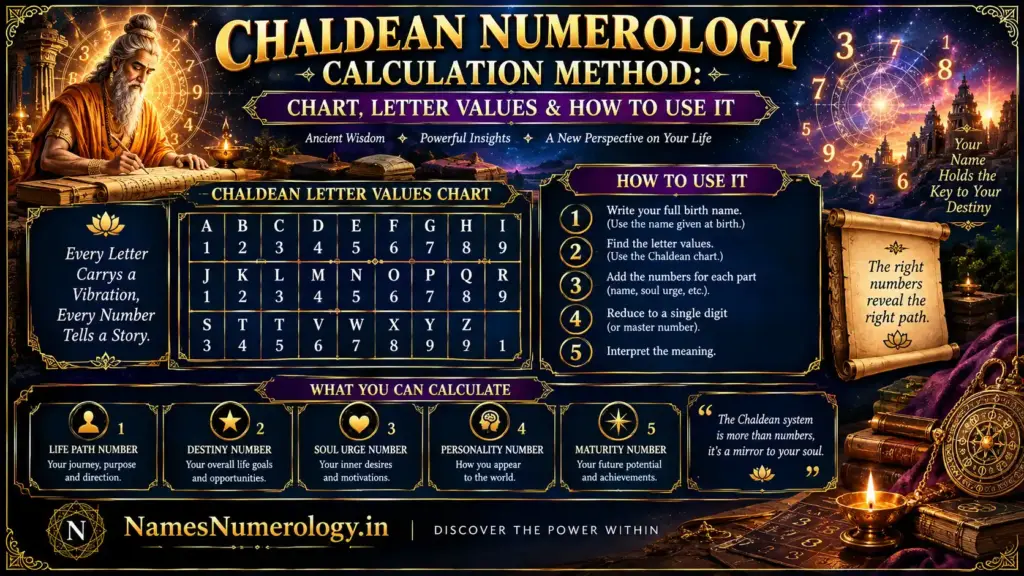
| Value | Letters |
|---|---|
| 1 | A, I, J, Q, Y |
| 2 | B, K, R |
| 3 | C, G, L, S |
| 4 | D, M, T |
| 5 | E, H, N, X |
| 6 | U, V, W |
| 7 | O, Z |
| 8 | F, P |
Note: No letters are assigned to 9 in the Chaldean system.
This table is the foundation of all Chaldean name calculations. Memorize it or keep it accessible whenever you perform a name analysis.
How to Calculate a Name Number Using Chaldean Numerology
Step 1: Write out the full name you are analyzing
For name corrections and personal name analysis, use the name as commonly used in daily life (how you introduce yourself, sign your name, etc.).
For birth name analysis, use the complete birth certificate name.
Example name: PRIYA MEHTA
Step 2: Assign Chaldean values to each letter
PRIYA: P = 8, R = 2, I = 1, Y = 1, A = 1
MEHTA: M = 4, E = 5, H = 5, T = 4, A = 1
Step 3: Add the values for each name
PRIYA: 8 + 2 + 1 + 1 + 1 = 13
MEHTA: 4 + 5 + 5 + 4 + 1 = 19
Step 4: Add the totals together
13 + 19 = 32
Step 5: Note the compound number
The compound number is 32. In Chaldean numerology, 32 is associated with communication ability, social magnetism, and popularity — particularly in creative or public-facing roles. This is a favorable compound number.
Step 6: Reduce to a single digit
3 + 2 = 5
The Name Number is 5.
Step 7: Interpret the result
A Name Number 5 in Chaldean numerology indicates versatility, dynamic energy, communication skills, and adaptability. Combined with the positive compound number 32, this name is considered highly favorable for someone in communication, media, teaching, or social roles.
The Meaning of Compound Numbers in Chaldean Numerology
This is where Chaldean numerology offers something the Pythagorean system does not: a rich vocabulary of specific compound number meanings. Here are the most important:
| Compound | Traditional Meaning |
|---|---|
| 10 | Rise and fall; success followed by difficulty if not grounded |
| 11 | Caution — associated with hidden dangers and betrayal |
| 12 | Suffering and sacrifice; may indicate being let down by others |
| 13 | Transformation through challenge; change and loss, but also regeneration |
| 14 | Movement and change; favorable for adaptable businesses and travel |
| 15 | Strong magnetism — attracts occult knowledge and powerful connections |
| 16 | The “shattered citadel” — pride and unexpected reversal; challenges requiring humility |
| 17 | Immortality — strong spiritual protection and lasting legacy |
| 18 | Conflict between material and spiritual; opposition and temptation |
| 19 | The “Prince of Heaven” — success, happiness, and fortunate outcomes |
| 20 | Delay and hesitation; requires patience before results materialize |
| 21 | The “Crown of the Magi” — great success and recognition |
| 22 | Master number — extraordinary potential for large-scale impact |
| 23 | The “Royal Star of the Lion” — protection, success, and high favor |
| 24 | Love and financial assistance; fortunate through partnerships |
| 25 | Strength through experience; requires careful judgment |
| 26 | Serious warnings — association with challenges, loss, and difficult partnerships |
| 27 | The “Star of the Magi” — authority, leadership, and command |
| 28 | Contradictions and loss of initial gains; needs stabilizing |
| 29 | Uncertainty and unpredictability — requires intuition and caution |
| 30 | Sacred isolation — mental brilliance but indifference to material pursuits |
| 31 | Isolation and loneliness; may indicate periods of solitude |
| 32 | Communication gifts and mass popularity |
| 33 | Creative talent and achievement; trusted advisor and friend |
| 34 | Good character bringing good fortune |
| 35 | Business talent and practical achievement |
| 36 | High intellectual achievement |
| 37 | Strong personal willpower and creative expression |
| 38 | Loss through misplaced trust |
| 39 | Competition, opposition, and legal difficulties |
| 40 | Limitations and restriction; discipline brings eventual success |
| 41 | Personal charisma attracting business and opportunity |
| 42 | Good fortune through partnerships and community |
| 43 | Revolution and change; political and social upheaval |
| 44 | Military strength and structured power |
| 45 | Wisdom and well-earned success |
| 46 | Ambition and leadership — commanding positions |
| 47 | Inner strength and perseverance bringing reward |
| 48 | Ambition frustrated by opposition |
| 49 | Achievement after difficulty |
| 50 | Strength, confidence, and stability |
| 51 | Individual strength and competitive achievement |
| 52 | Power and influence through communication |
Chaldean vs. Pythagorean: Key Differences in Practice
| Feature | Chaldean | Pythagorean |
|---|---|---|
| Origin | Ancient Babylon | Ancient Greece |
| Number 9 assignment | Not assigned to any letter | Assigned to I, R |
| Compound numbers | Central to interpretation | Generally not emphasized |
| Name used | Name in daily use | Usually full birth name |
| Popularity in India | Strongly preferred | Also widely used |
| Complexity | Higher | Lower |
For deeper name correction work — particularly the kind where a single letter change could shift outcomes — the Chaldean system is generally considered more precise.
Common Mistakes in Chaldean Calculation
Using the Pythagorean chart by accident
The most common error is applying Pythagorean values while believing you are using Chaldean. Always double-check your letter value table.
Ignoring the compound number
Reducing to a single digit without noting the compound misses crucial information. The compound number often tells you more than the final digit.
Using the wrong name
In Chaldean practice, the name that matters is the one in active daily use — not necessarily the legal name if it is not used.
Adding incorrectly under time pressure
Numerology errors almost always come from arithmetic mistakes. Write out every letter’s value explicitly before adding.
Practical Application: Name Correction Using Chaldean
The primary practical application of Chaldean numerology is name correction — adjusting the spelling of a name to shift its compound number into more favorable territory.
For example, if a name produces compound number 16 (the “shattered citadel” — associated with pride and unexpected reversal), a numerologist might suggest adding a letter or adjusting a spelling to shift it to compound number 19 (“Prince of Heaven” — success and fortune) or 23 (“Royal Star of the Lion”) while keeping the name recognizable.
The Life Path Number (from birth date) is also taken into account — the final single-digit Name Number should be compatible with the Life Path Number for the correction to be considered harmonious.
Final Thoughts
The Chaldean numerology method is a sophisticated, ancient system that rewards careful application. Its unique features — the sacred status of 9, the compound number vocabulary, and its emphasis on the name in active use — make it particularly powerful for name analysis and correction.
Invest time in learning the Chaldean letter value chart and the compound number meanings, and you will have a genuinely useful tool for personal and professional name evaluation.
Related articles:

Keep reading
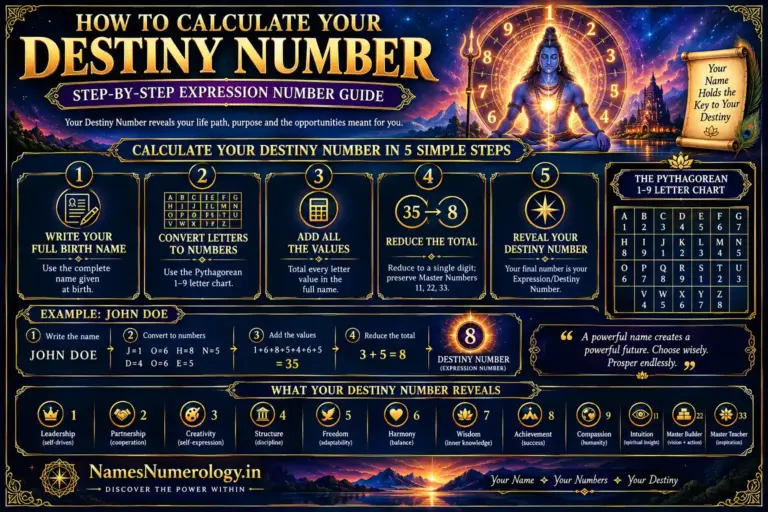
How to Calculate Your Destiny Number: Step-by-Step Expression Number Guide
Learn exactly how to calculate your Destiny Number (Expression Number) in numerology. Step-by-step guide with examples, Pythagorean chart, and meaning of each result.

Is Numerology Accurate? Does Numerology Really Work?
An honest look at whether numerology is accurate and how it works. Explore what science says, what practitioners report, and how to approach numerology…

Which Numerology Number Is Best for Me? How to Find Your Ideal Number
Discover which numerology number is best for you personally. Learn how to find your life path number, what makes a number 'best,' and how…